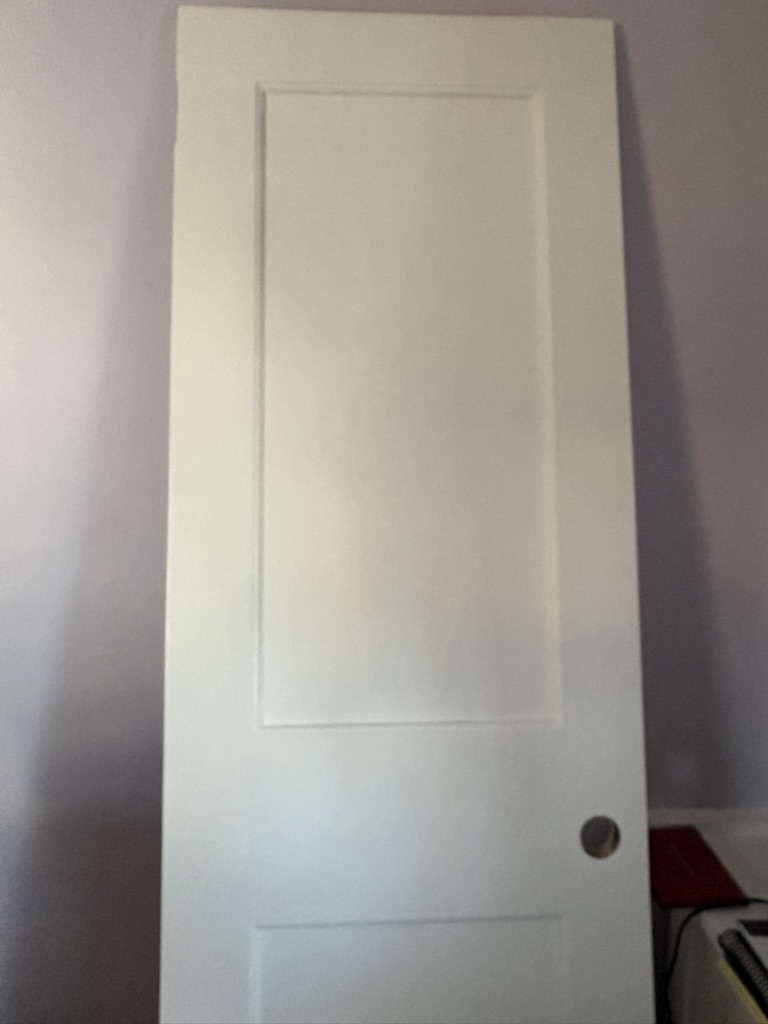
I’m the Michelangelo of Doors
I consider my house a monument to myself, therefore it is exceptionally cute. I live in a street tree neighborhood, with sidewalks and houses close enough together to walk places. The hardwood floor is real, every room has crown molding, built-in bookshelves surround a working fireplace, and daytime brings plenty of natural light through large windows. And, of course, I’ve filled the yard with hundreds of flowers.
I love my house, but I’ll admit it has some quirks. Since it was built in 1941, it was constructed on two steel I-beams. There are as many outlets in the entire house as in a single great room of a home built today. And, some of the construction techniques are a bit… outdated.
Despite my chronic bad luck, I somehow avoided asbestos, which was commonly used for insulating pipes and attics. I credit my house’s complete lack of insulation for this food fortune. (Yes, I have added insulation since.)
Unfortunately, my house had lead paint. I knew before I closed that I would likely have lead paint because of how common it was in the 1940s. Anytime I started a project that would disturb paint, I would use the 3M LeadCheck strips (which I know aren’t 100% perfect but they were what I had), and lo and behold, the olive green paint hidden under two layers of white and salmon on my upstairs hallway doors and doorframes was chock full of lead.
Fortunately, this paint was only exposed in tiny places where the door and frame rubbed. It really wasn’t dangerous because it wasn’t creating dust that I would inhale or ingest. If I had children, pets, or a normal person’s attitude toward homeownership projects, I would have simply painted over these spots to halt any further chipping.
Instead, I chose to remove the lead paint.
Why did I do this? At the top of the list is a previous homeowner completing extremely poor paint jobs on the doors, leaving them with weird lumps. I also had some weird sense of civic duty, that it was my responsibility to eliminate the lead paint when there were no children in the home. And I’m a little crazy.
Various government agencies and safety commissions describe lead paint as a serious, deadly issue–which, don’t get me wrong, it can be. But these alarmist websites had very little information on how to abate the lead. Thus, I will share my lead wisdom with the world.
A quick note before we journey into the oddly satisfying process of removing lead paint: Wear gloves and eye protection when working with caustic materials like paint remover, and use a high-filtration mask if there’s a risk of creating dust. Otherwise, you may be subjected to dealing with the American healthcare system.
Back to our project. First, remove the doors, write on the top or bottom where each door came from and what direction it was hanging, and take them outside. Take off the hinges and doorknobs, and any other hardware, like the marginally creepy deadbolt that was on my bedroom door, and put them in an old pot. Dump some baking soda in the pot, add water, and boil. When you become impatient, remove the hardware and you’ll be able to clean off any paint or mysterious substances.
Next, obtain copious amounts of cling wrap and Citristrip, which can be found in most hardware stores alongside other paint strippers. Citristrip comes in a gel and a paste. I recommend the past for higher-up places as it drips less, and the gel for large spaces because it spreads more easily. Using a paint brush, apply the Citristrip to everywhere you’ll need to remove paint. Slap on the cling wrap immediately because it works better if the Citristrip doesn’t dry.
After a few hours, return to your project and peel off the plastic. Most of the time for me, the top layers of paint came off with the plastic. You’ll then need to take a paint scraper and “shave” off the Citristrip and any additional paint that’s become liquid. Don’t try to scrape off remaining paint–it’s better to do another layer of Citristrip for both time and safety reasons.
Dump your paint/Citristrip concoction into a plastic container or bag and seal it up. In my area, we’re directed to put these materials into the trash because it gets incinerated. This might be different where you live. But, don’t be surprised if the answer is to double bag it and toss it in the trash because modern garbage dumps and incinerators are designed to contain contaminants.
After you’ve done enough layers of stripping that you’re down to bare wood, wipe everything down and putty and sand those dents and drips that have been making your eye twitch.
Then it’s prime time. You’ll usually need two coats of primer, applied thinly, with sanding and wiping with a wet cloth between layers. Finally, when your door is smooth and primed, you’ll put on at least two layers of paint. I recommend picking a paint on the upper scale of gloss so you can wipe off dirt. You could also choose cabinet paint, which is extremely durable.
Rehang the doors using the clean hardware and voila! You have eliminated the lead crisis.
I started this project two or three years ago, and today I applied my last layer of paint. And let me tell you, the door is so beautiful. I mean, it’s a white door, very standard. But it’s smooth and clean, and very door-like.